Debby L. Feinberg, Mark S. Rosner, & Arthur J. Rosner
Published in the journal Otology & Neurotology, Vol. 42, No. 1, 2021
OBJECTIVE
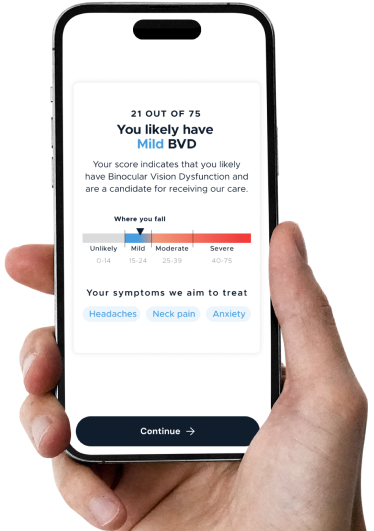
Curious if you have Binocular Vision Dysfunction? Take the assessment to get your score and get relief.
Among patients presenting with dizziness, visual dysfunction must be considered, including vertical heterophoria (VH), a frequently under-identified form of binocular vision dysfunction where there is vertical discrepancy between the lines of sight of the eyes when at physiologic rest. Current self-rated screening measures do not account for complex VH symptomatology including dizziness/ambulation difficulties, nausea, headache, anxiety, neck pain, and reading impairment. VH must be differentiated from vestibular/otolithic etiologies, as their treatment frequently provides inadequate relief, yet treatment of the VH can reduce/eliminate symptoms. The objective of this study is to create a valid measurement tool (BVDQ™ Assessment) to assist in identifying VH among dizzy patients to aid in appropriate referral.
Study Design:
Retrospective case series.
Setting:Tertiary referral center.
Patients:
One hundred twenty-six patients presenting to an optometric binocular vision subspecialist diagnosed with VH.
Intervention:
Psychometric study. The measurement tool’s internal consistency and test–retest reliability was assessed.
DISCUSSION
The identification of VH is pertinent to otologists because of the overlap with vestibular symptomatology. Dizziness and vertigo were very common symptoms (70 and 36.5%), making it critical to determine if VH is the etiology, since traditional treatment approaches frequently provide inadequate relief if vision misalignment is causative. Fifty-two patients (41%) had been seen by an otolaryngologist and 60 patients (48%) by a neurologist before VH being diagnosed by a NeuroVisual Medicine specialist. Duration of symptoms before treatment was an average of 7.6 years. Earlier identification of these individuals would presumably result in lowered healthcare costs and reduced overall morbidity from VH. The BVDQ seems to be a valid, reliable measure of symptom severity related to BVD, making this useful as a screening tool for VH and other BVD-related concerns. While our findings have validated the effectiveness of the BVDQ for screening potential BVD patients and tracking patients’ responses to treatment, it is hoped that this measure can reduce the cumbersome task of administering and tracking multiple symptom survey tools. The specific combination of symptoms, degree of symptom severity, and degree of symptom frequency are unique for each patient. Thus, the BVDQ may help clinicians identify both primary and adjunctive symptom domains of BVD patients. Taken together, these findings suggest that the BVDQ may be uniquely suited for identifying potential BVD patients in clinical settings among patients presenting with dizziness.
Read the full research paper with figures (PDF)
What Is the BVDQ™ Assessment?
The BVDQ™ Assessment is the first step in determining if you may have the condition. It asks questions regarding your experience with various symptoms, how long they have lasted, and their severity. There are specialized assessments for adults and children.
Why Should I Take a BVDQ™ Assessment
If you have seen several specialists, but none of their treatments have helped, you should take the BVDQ™ Assessment. If you have been diagnosed with ADHD or other learning disabilities, you should also take the assessment to help determine if BVD is contributing to or maybe even causing your condition. An examination from a BVD specialist can determine if you have BVD. Symptoms of BVD are common to other conditions and might include:
- Blurred vision
- Headaches
- Problems reading
- Neck and shoulder pain
- Dizziness; difficulty with gait & balance
- Poor depth perception
- Double vision
- Peripheral vision issues
These symptoms can make it challenging to do your everyday tasks at home and work. They can also bring on other problems, such as anxiety and issues with crowded spaces or driving on freeways that make it hard to live your life fully.
Benefits of the BVDQ™ Assessment
If you have been fighting vision and related problems for some time, the BVDQ™ Assessment can help you finally get some answers. It can also help you learn more about your symptoms and how they affect your life. It is not unusual to stop noticing symptoms as you adjust your life around them. But you don’t have to live like this, and taking the assessment can help get you the help you deserve.
Taking the BVDQ™ Assessment can also lead you toward getting proper treatment. Once a NeuroVisual Medicine specialist evaluates your assessment, they can contact you with the next steps. This puts you on a path toward treatment that can alleviate or eliminate your symptoms.
How Do I Know if a NeuroVisual Medicine Specialist Can Help Me?
A scientifically validated assessment has been developed by our researchers to screen for Binocular Vision Dysfunction. Find out if a NeuroVisual specialist can help you!
Curious if you have Binocular Vision Dysfunction?
Take the assessment to get your score and get relief.
Learn more